

Subscribe to:
Post Comments (Atom)
skip to main |
skip to sidebar
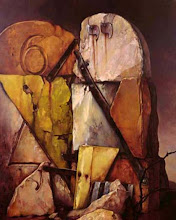
by Samuel Bak
OT00443B1 New Brunswick Theological Seminary
Memorial
by Samuel Bak
News Sites for Consultation
Linking to the Decalogue...
Blog Archive
-
▼
2009
(29)
-
▼
08/30
(13)
- Course Syllabus
- Class Chat Room
- Decalogue Poll No. 1
- Decalogue Poll No. 2
- PPT: Seeing the Other
- PPT: Re-Reading the Bible for the Other
- Welcome to the Ethics of the Decalogue
- Groups for Assignments
- Class Chat Room
- Blog Post No. 4: Kieslowski Film (Due 9/10)
- Blog Post No. 3: "Memorial" by Samuel Bak (Due 9/10)
- Blog Post No. 2: Readings in Coversation (Due 9/10)
- Blog Post No. 1: The Book of the Covenant and the...
-
▼
08/30
(13)
I think the philosophy of greatest significance according to Levinas is that of ethics/doing justice. He says, "it is better to help others than to help ourselves..." (page 11) This reach for justice surpasses knowledge, science, intellect, truth. Individualism is seen as evil. We are our brothers' keepers and are responsible for humanity. We are part of a whole,not just our own selves or families, but of all of creation, and the most important thing is to give ourselves for the good of another.
ReplyDeleteLevinas relates ethics and justice from the lens of the "other". Morality cannot be separate from an inherent consideration and concern for the other before self. Humanity is interactive with all of God's creation and not focused solely on the human being. His relational theory forms the foundation for ethics which is in tension with a philosophical understanding of ethics.
ReplyDeleteI think this painting of Samuel Bak retraces the story of the Israelites from the time of the dstruction of the Temple of Jerusalem ca 70 AD by the Romans. It shows how the city was in ruin thereafter. Even though the situation of the Israelites was unbearable, they were trying to re-member what left after the destruction of the Temple and city and found out where they fell short before Yahweh. It was apparent that God continued to take care of them in the midst of distress and tribulation. The eating utensils appeared to be broken and still there was fruit for them to eat. This shows the faithfulness of God to His chosen people. One of the slides shows a key accompanied by a book. This can represent the book of the law which God called the people to respect and obey if they needed to be victorious and successful in their interprises. This ensures to the people that they will be successful if and only if the book of the law does not depart from their mind and heart. There was another slide that shows the the rebuilding of the city and thus the Israelite's life. Another slide show the people as zombies. Their faces look like dead people faces. It was a moment of desolation and despair. This reminds me the picture of the Jews going to death camps during the Hitler's era in Germany. Another slide shows the people regaining their joy again in the Lord. They were playing instruments. The last slide shows the red sea behind them. This scene looks like they were still in the desert.
ReplyDeleteMy personal impression is that God is with us in the middle of tribulations and trials. All we need to do is to re-member where we fell and come back to implore God's mercy. It was a good piece of painting to analyze and ponder upon.
Cohen suggested the philosophy of Levinas lie in the question 'what is most important?' Is it knowledge? No, according to Levinas knowledge can still remain uninformed and indifferent to humanity and truth. Aesthetis can lead us into narcissism or and selfish vanity. Levinas pulls from Shakespeare and says..is "to be or to be" the most important question? He argues no! He believes the the more signifigant question lies in how does one's being justify itself? By our loving-kindness to the other? Our concern for the stranger or the helpless in need? The higher self is discovered and transformed in these actions and our deepest relationship becomes a vertical one to God, we enter into the stream of humanity that reaches new heights, beyond the limits of knowledge and aesthetics--to this kingdom of God on earth.
ReplyDeleteCohen makes a strong claim for the turning point to a postmodern harmony of revelation and reason. He argues and explicates the philosophical claims of Levinas, claims about ethics, about thinking, about exegesis, and so forth. His moral style is self-conscious and is obvious. And it dares us to ask ourselves why this moral tone is almost embarrassing for philosophers? Levinas himself wrote with great rhetorical force, attacking many positions, but also listening to the ethical searching in the thinking. One has only to see his reading of Descartes to see this rehabilitation of a truly ethical aspect in a thinker who has so often been identified as the origin of what is wrong in modernity. The moral tone of Cohen’s work is content to label some ways of thinking as bad, even evil. For the proper companions are the others with whom I do not agree, who are still other. To acquire a companion requires patience, even passivity, and a listening to learn even from those who refuse to recognize the primacy of ethics. Cohen teaches us one way to become a student, by offering a bold presentation of the priority of ethics.
ReplyDeleteTitus Kim
For Levinas, justice is the very important and cannot be achieved in a vacuum. Levinas argues that one cannot only seek justice for those in their immediate sphere i.e. family and friends. One is called to seek and obtain justice for all, including those who are different and even for “others” who may not seek justice on our behalf. Levinas is clear that we are responsible for all of humankind and we are bound together since we are all God’s creation. As a part of God’s creation, we should advocate for the whole of His creation not just for our small part in His creation. We must realize that we must be concerned for the “other” and that the fate of the “other” will affect all. We must use more than knowledge. For Levinas, knowledge is not as important as caring for the good of the other even before we consider ourselves.
ReplyDeleteIt seems to me that as I look at my notes from the reading, it began with Morality being the greatest significance. However, as I continued to read: ethics, knowledge morality and justice all seemed to be woven together. Primarily ethics being "the demands of morality and justice" (5), seems to believe that they give energy to one another, the word synergy came to mind when I read that.
ReplyDeleteIt seems that when we live out of our morals, seeking justice we are noticing and caring for our sister and our brother. As he writes "Just is the public face of morality." (14)
Cohen explains that the greatest significance, as Jesus also mentions, is that we should "Love thy neighbor as oneself" (page 11). By loving our neighbor as oneself, we are able to keep a good relationship with eachother, hence, we are in good relationship with God.
ReplyDeleteAdultery Group
Is it possible that after all that intellectual energy invested in Levinas
ReplyDeletephilosophical argument to the too intelligent, too sophisticated, too cultural
that he too came to the conclusion pen by the Hebrew writers that it is better
to be good than anything else. it is better to help others than to help
ourselves. Nothing in the world is more precious than serving others. I am my
brothers' keeper. Love thy neighbor is oneself. However Professor Ricks is right
about one thing if you are not a avant reader of philosophy it make hard
reading.
Levinas philosophy would argue that morality was of greatest significance. Cohen says, "For at stake in morality is our highest individual and collective vocation, the very humanity of the human." The maintenence of morality can only be done by rejecting the greater influence of "knowledge" and "experience" in order to arrive to the end that justice and ethics are accomplished.
ReplyDeleteQuentin Sutton/Danielle Brown
Sabbath Group
Cohen write, "only ethics can judge." In this statement lies the importance of ethics. Ethics is that thing that keeps one from ignoring what is unlike themselves. Ethis is a force that over rules ones own fixation on his or her identity by stirring up responsibility and outweighing power.
ReplyDelete