How does painting "Memorial" by Samuel Bak inform your understanding of the Jewish experience of the Ten Commandments in light of the Holocaust. How does the painting impact you?
To see the paining, click on the link below.
"Memorial" by Samuel Bak


Subscribe to:
Post Comments (Atom)
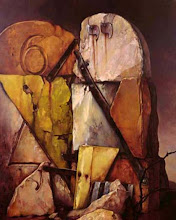

The tablets are cracked and bloody. The number 6 at the top references the sixth commandment, which was broken millions of times during the Holocaust. There are swords running through the Star of David. A chisel seems to be cutting through rock. At the bottom, the shapes could be bodies broken and dying. Even with the damage to the tablets they still stand. Perhaps for Post-Holocaust Jews, the piece indicates that through it all, the Lord's law for God's chosen people is still relevant and is mightier than the evil of the Nazi experience. Personally, I find the painting horrific. It brings to mind photos of the concentration camps and the expressions in the eyes of the tortured.
ReplyDeleteThe Old Testament is full of stories where the people of God has built memorials or dug wells to remind them of God’s salvation or some other testament to remind them of their journey through the unknown a visual reminder for generation to come. But in this memorial I see a broken defragmented people, not sure what lays ahead for them. In OT the people of God knew where they were head (to the promise) land but here in light of the Holocaust it appears as if the artist is saying we have been strip of everything that makes us unique but we must never forget what has happen and it is our history our uniqueness that will bind us as a people. It is full of symbols and stones. It is the stones I find most prolific the stones say we are here to stay we are permanent, unmoved, unshakable
ReplyDeleteThe image of the disconnected tablets with the number 6 for "thou shall not Kill" shows how devastating a violation of this commandment was for our Jewish brothers and sisters. The gun forming the star of David shows the struggle between religious beliefs and the reality of living in a world where one's faith is tested day to day in society. Despite the disconcerting symbols I noticed the colors used are still vibrant yellows and matted oranges which in my opinion speaks of hope in the midst of suffering.
ReplyDelete"Ruins and remnants". I couldn't help but attach myself to those words in the article abot Bak's work. His piece Memorial, speaks to ruins and remnants. A holy set of Ten words that seems to be in ruins after an act of despicable measure--humankind's own fear and hate turned on itself. There are remnants of tablets, but they are fragmented and soiled. The remnants of a Jewish star of David is intact, but again broken and a bit deconstructed. So it still stands, the tablets, fragmented, soiled and broken, but standing firm. These look heavy..solid. These stone tablets will not be budged. I see that as one of Bak's messages. Amid the conflict, the shadowy messages of genocide, the dissonance and contradiction of people's actions, there is the word of YHWH and the people of Israel, YHWH's chosen. Thus says the Lord (quoting from one of those cool prophet directives!)
ReplyDeleteI once heard the Commandments described as something that is not here to confine us, to 'fence' us in, but rather to protect us from falling into the pit of these lifestyles. To invite us to open our eyes, look around and see all that is for us. As I look at the painting, see the broken tablets, and the number 6, I see relationships with eachother, community broken. The last 6 commandments are about nieghbor relations and living in community, and the Holocaust clearly broke these relations. I did read the corresponding article by Steve Charles and after reading the article, looking at the painting, we have to hear Phillips' questions/thoughts "The question becomes not, 'Why does God permit suffering? but 'What steps can I take now to intervene in the suffering of another?" We are called to live in community with one another, what would have gone differently had people worked harder, more intentionally to live differently? This painting reminds me that not only are the Commandments present to protect me, but more importantly for me to protect and keep whole the lives of others around me.
ReplyDeleteThe “Memorial” by Samuel Bak is consistent with the Book of the Covenant and for me is about restoration and restitution. In the painting, the Ten Commandments are broken but held together by the Star of David. The name of God can still be seen on the tablets. During the Holocaust, all of the commandants were most likely broken and shattered but the name of God is still on the tablets in the painting. Which for me symbolizes that God is still in covenant with His people. The laws are held together by the hope of the Star of David and the promises of God as signified by His name still on the tablets. God will in spite of the broken laws, dreams, and lives bring restoration and restitution to His chosen people. Also in the bottom of the painting, it looks like wire from a Concentration camp. However, the wire also reminds me of the thorns that were placed on the head of Jesus on the cross. Therefore, we must remember that Christ died and suffered for us and by His stripes, we are healed and redeemed.
ReplyDeleteThis comment has been removed by the author.
ReplyDeleteThis comment has been removed by the author.
ReplyDeleteSorry for the mistakes above...
ReplyDeleteHow does painting "Memorial" by Samuel Bak inform your understanding of the Jewish experience of the Ten Commandments in light of the Holocaust. How does the painting impact you? His paintings express a serious attempt to deal with his survival. I noted throughout his works to create new visual insight for interpreting the Holocaust, through both his own suffering and as a metaphor for specific and universalized disturbances. Indeed, the images in his art, it reminds me the power of images. It remains longer, and gives messages regardless different generations. Also, his works give me a challenge what would I do to make a difference in the world today.
Titus Kim
The painting defeinitely is reflecting on the 6th commandment of "You shall not murder" (NIV). However, in the "essence" of speaking about the relationship between fellow humans and how Cohen mentions the significance as being "love thy neighbor as oneself" we would like to ask a simple question: When the Natzy's murdered the Israelites it's breaking the law (relationship) however, is it not breaking the law when the Israelites are murdering the Palestinians?
ReplyDeleteAdultery Group
This painting reminds me that in the midst of the Israelites suffering, was their covenant. No matter what tribulation they suffered, God's covenent with them remained. This could carry great implications for the way that they would view such covenant in the future. Either the covenant would be cherished and celebrated or could be viewed as the reason for their suffering and therefore something to dread.
ReplyDeleteQuentin Suttin/Danielle Brown
Sabbath Group
The painting "Memorial" depicts the Jewish experience of the 10 commandments in that the structure takes on the shape of the original pillars. The pillars are put bact together with the experiences that the people have come through. It is evident that the structure had been broken apart like the breaking of the commandment by God's people over the years. The brokeness changed the view of the commandments but the commandment still stand and have significance for the people. The physical broken state of the commandments show us that the commandments may have been altered and adjusted to fit changes that we undergo but they are still relevant to Godly living.
ReplyDelete