

Subscribe to:
Post Comments (Atom)
skip to main |
skip to sidebar
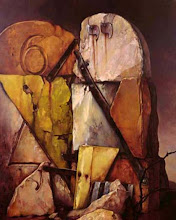
by Samuel Bak
OT00443B1 New Brunswick Theological Seminary
Memorial
by Samuel Bak
News Sites for Consultation
Linking to the Decalogue...
Blog Archive
-
▼
2009
(29)
-
▼
08/30
(13)
- Course Syllabus
- Class Chat Room
- Decalogue Poll No. 1
- Decalogue Poll No. 2
- PPT: Seeing the Other
- PPT: Re-Reading the Bible for the Other
- Welcome to the Ethics of the Decalogue
- Groups for Assignments
- Class Chat Room
- Blog Post No. 4: Kieslowski Film (Due 9/10)
- Blog Post No. 3: "Memorial" by Samuel Bak (Due 9/10)
- Blog Post No. 2: Readings in Coversation (Due 9/10)
- Blog Post No. 1: The Book of the Covenant and the...
-
▼
08/30
(13)
The complication was the lie that the woman told to save the underground resistance movement. In so doing, she was willing to let the little girl be captured. When is bearing false witness OK? When is bearing false withess excused? This complication comes up for us in small ways when we choose to tell "white lies" in our day to day lives. "How do you like this outfit?" (it looks terrible but you don't want to hurt the person's feelings) or "tell them I'm not home" (when you don't want to take a call) or "I'll always love you" (until tomorrow). It is easy and convenient not to tell the truth, especially if you think you're saving the feelings of someone else. I don't think I identify with this complication any longer, because I've learned the art of not answering questions rather answering what I call "inauthentically".
ReplyDeleteTo trade a life out of fear to save a life a lie was told and these lies or false witness bare fruit that effect a person entire life both the witness and the accused. I identify this problem every day. In my world a convicted felon is just that a convict, with no creditability. An officer on the other hand has all of the creditably and support. If an inmate make an allegation against an officer immediately his allegations are brought into question, however the officer can use false witness against the inmate to have him remove from the housing unit, jobs, education and so forth. These allegations can follow the inmate for the rest of his stay in prison; it is my job to discern what is true and what is false. Should I uphold the charges made by the officer knowing that the officer has a history of false statements or should I side with the inmate to save him from further punishment?
ReplyDeleteThe film depicted that the commandment does not occur in a vacuum. Laws designed for the good of society can at times perpetuate the evils of society. Each person in the film dealt with the "bearing of false witness" in order to protect their lives and the lives of others from an oppressive and violent regime of terror. I wonder if their sin of false witness is forgiven based on the context and staus of the society they lived within.
ReplyDeleteLisa
Levinas has shed not light, but deep confusion about this issue for me. I would have agreed with Lisa before Levinas, but now I am conflicted. Levinas talks about the 'absent others' who would suffer should I focus on the singular other in front of me who is in need and neglect the absent one. Levinas believes morality can engender injustice, but he does flip it to say that justice itself is dependant on morality and justice will rectify morality in the end. What was the moral thing to do here? Hide Elisabet and lie about her religious/ethnic identity or protect the underground resistance that did save the lives of others like her? Yet there was a contradiction between the act of justice and the morality of saving Elisabet, and Levinas did not believe the two should oppose.I suppose I agree with what the woman did, not for the pious act of truth; although she did say it would force her to lie before her God (cover story), but for the act of justice carried out. According to Levinas' notion, her act of justice was still selfless and had deep concern for the other. Perhaps this was the 'difficult freedom' Levinas spoke of when he wrote " Aiming in the direction of the good, through concrete actions that help the other before oneself, and creating the lasting institutions of a just society--these are the heights of human life, the very 'humanity of the human'."
ReplyDeleteIn the Kieslowski film, both parties would have had to bear false witness. The little girl would have had to state that she was not Jewish and the professor did bear false witness to “protect” the “greater good of the movement”. This can be seen a justice, since often when justice is provided to one it is taken from another. The film provided an excellent example of how hard it is the see the world in black and white when life is often shades of grey.
ReplyDeleteIn the film, one of students in Sofia’s ethic class brought an ethical dilemma for consideration. It is about the life of a child. And Sofia comments that nothing is more important than the life of the child, then Elizabeth(?) brought her story that happened during the World War II. It is also about the life of a child in danger and it drives to one of the Ten Commandments, "Thou shall not bear false witness." This film impact our words and behaviors toward others which put us in terms of complex moral dilemmas. This is true, but superficial. Choices are crucial, but they are not the only people who determine of the dilemma. It has message to us for the things involves a mysterious confluence of what's within our control and what lies beyond it.
ReplyDeleteTitus Kim
I have to say that I love how out of the box this film series is, and yet in reality it is not out of the box because it has just brought to surface how gray issues are, and how everything we do, say or live out can be and should be filtered through these 10 commandments. The one thing that replays in my mind is the lives portrayed and how they had to live with the decisions they made and wondering or living in fear and isolation because of the words we speak or did not speak. Spoke volumes to me in that regard.
ReplyDeleteThe complication of the film reveals the broken relationship which is the consequences of the three characters (Lady Professor, Girl, Tailor) through second-hand experience of "false witness." We would like to emphasize that relationships are fragile, as it can be broken even if the individuals were not the ones to bear "false witness."
ReplyDeleteAdultery Group
I think we have all come to the fork in the road where either choice would yeild adverse consequences. The film reiterated that what seems like justice to one can be a tragic injustice to another.
ReplyDeleteQuentin Suttin/Danielle Brown
Sabbath Group