

Subscribe to:
Post Comments (Atom)
skip to main |
skip to sidebar
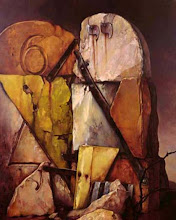
by Samuel Bak
OT00443B1 New Brunswick Theological Seminary
Memorial
by Samuel Bak
News Sites for Consultation
Linking to the Decalogue...
Blog Archive
-
▼
2009
(29)
-
▼
08/30
(13)
- Course Syllabus
- Class Chat Room
- Decalogue Poll No. 1
- Decalogue Poll No. 2
- PPT: Seeing the Other
- PPT: Re-Reading the Bible for the Other
- Welcome to the Ethics of the Decalogue
- Groups for Assignments
- Class Chat Room
- Blog Post No. 4: Kieslowski Film (Due 9/10)
- Blog Post No. 3: "Memorial" by Samuel Bak (Due 9/10)
- Blog Post No. 2: Readings in Coversation (Due 9/10)
- Blog Post No. 1: The Book of the Covenant and the...
-
▼
08/30
(13)
The "essence" of the Book of the Covenant is about justice for those who have been wronged, who are "less than", and the importance of hospitality to strangers. Twice there is a reminder that the Hebrew people were once strangers in Egypt. The commandments are referenced particulary against theft, killing, the sabbath, and idolatry. There are explanations of why the commandments are important and consequences for not following them.
ReplyDeleteDebbi Jackson
Exodus 21-23 (the Book of the Covenant) maintains the “essence” of the Ten Commandments because it lends itself to extend further details of the law and examples of the intentions of God words, for example the tenth commandment “Thou shall not Covet” Ex.20: 17 convey what you should not covet however Ex. 22: 5-27 provide examples and reveal what might be hidden agendas of the heart. I see it as an clarification of God’s law.
ReplyDeleteExodus 21-23 maintains the "essence" of the Ten Commandments by expounding on specifics of some of the commands. There is this emphasis on four fold and seven fold restitution and retribution for violation of the command. The focus is also mainly on the commands dealing with relating to the "other" (aliens, women, orphans and widows).
ReplyDeleteThe Book of the Covenant and the Ten Words speak to formation several levels.
ReplyDelete1) Both spoke to a formation of YHWH's chosen people as they had been slaves and refugees without any identity, except YHWH's promise that they would be a holy nation--a chosen people.
2) Basic laws of society neeed to be established. When a people are wandering, governing laws tend to be of minor importance.
3) This was a relational attempt by YHWH to establish and begin formulating a relationship with the people. Relationship to YHWH could only take place in relationship with others--the community and the alien or stranger among you. These were inseperable for YHWH and both the 'Words' and the Covenant Collection speak to the vertical relationship to YHWH, but speak in much greater detail how a holy nation should treat eachother and the stranger among them.
I think this painting of Samuel Bak retraces the story of the Israelites from the time of the dstruction of the Temple of Jerusalem ca 70 AD by the Romans. It shows how the city was in ruin thereafter. Even though the situation of the Israelites was unbearable, they were trying to re-member what left after the destruction of the Temple and city and found out where they fell short before Yahweh. It was apparent that God continued to take care of them in the midst of distress and tribulation. The eating utensils appeared to be broken and still there was fruit for them to eat. This shows the faithfulness of God to His chosen people. One of the slides shows a key accompanied by a book. This can represent the book of the law which God called the people to respect and obey if they needed to be victorious and successful in their interprises. This ensures to the people that they will be successful if and only if the book of the law does not depart from their mind and heart. There was another slide that shows the the rebuilding of the city and thus the Israelite's life. Another slide show the people as zombies. Their faces look like dead people faces. It was a moment of desolation and despair. This reminds me the picture of the Jews going to death camps during the Hitler's era in Germany. Another slide shows the people regaining their joy again in the Lord. They were playing instruments. The last slide shows the red sea behind them. This scene looks like they were still in the desert.
ReplyDeleteMy personal impression is that God is with us in the middle of tribulations and trials. All we need to do is to re-member where we fell and come back to implore God's mercy. It was a good piece of painting to analyze and ponder upon.
test c rix
ReplyDeleteI am sure that the book of the covenant in Exodus 21-23 is similar to the Decalogue. The Decalogue is one of the keys to understanding the Old Testament. Every commandment is the heart of Mosaic revelation. And it is possible to group most of the provision of the book of the covenant in Exodus 21-23. The significance of this can be overemphasized. When God saved Israel, He did so as a nation. The nation is composed of individuals, with its corporate witness equal to the sum total of the godliness of every Israelite.
ReplyDeleteTitus Kim
The “essence” of the “Book of the Covenant” (Exodus 21-23) is similar to the Ten Commandments in that they both provide laws and guidelines on how to live in right relationship with both God and Man. Both the “Book of the Covenant” and the Ten Commandments provide “laws” or guidelines on how to serve God by having no other gods, keeping the Festivals, giving God the first fruits and remaining in covenant with Him. Both also provide guidelines and “laws” on how to live with each other, including the “others” who are those we may not know or are different from us.
ReplyDeleteThe “Book of the Covenant” appears to me to be more focused on restoration and restitution than the Ten Commandments, which does not provide the level of specific detail found in Exodus 21-23. While both state that, we should treat “others “well. Exodus 21-23 is very clear in specifying who the “others” are such as widows, orphans, women, travelers, the poor and oppressed. The “Book of the Covenant” is also very clear that God’s elect should not take advantage of each other and those we consider “outsiders”. God reminds His people that they were once the “others” or “outsiders”.
I would have to agree with Valerie on her thoughts as she states them very well. However I would add to them that Commands or Ordinances refer to the way in which one should live in relationship with one another. Both these seem to be very detailed and descriptive in explanation. The Exodus 21-23 passage also included the Lex Talionis, the law of retributive justice...again, maybe some perameters as to how we are called to live within community and relationship with one another.
ReplyDeleteThe "essence" of the Ten Commandment and the Exodus 21-23 reveals to us that in trying to keep our relationship between God we cannot deny our relationship with fellow human beings. The law which is given by the Ten Commandments and the elaborations found in Exodus 21-23 both explain the "essence" of keeping a healthy relationship between our brothers/sisters in order to keep a good relationship with God.
ReplyDeleteAdultery Group
The Decalogue is a major part of the history and narrative of the Israelite people as it marks the point where YHWH spoke directly to them concerning their responsibilities as YHWH’s own people. As those who were chosen as YHWH’s own, the Israelite people had a responsibility to keep YHWH at the head of their lives and devotion. They were also responsible for maintaining community with one another as a reflection of YHWH’s covenant with them. These verses serve as YHWH’s code of conduct for the Israelites as they maintain their relationship with YHWH and one another and the resources that they had been afforded by YHWH’s grace. While the essence of the Decalogue is very similar to that of the Ten Commandments; the Decalogue expounds and proactively reveals the consequences of Israel’s disobedience and disregard for the covenant.
ReplyDeleteQuentin Suttin/Danielle Brown
Sabbath Group