Bak's focus on Albrecht Durer in Elegy III served 'as a desire for revenge'. His comment pushed me to think about Durer and this piece. A German artist whose focus was on linear perspective,geometry of form, ordered ruled for beauty and certainly detail, Durer seems lost and conflicted here (as he holds a ruler). What does he make of all this brokenness? The boy's face seems to be disappearing,the architectural form of an arch (a rainbow?) is held up by a rope; all of the non-linear fragmentation that he sees questions his aesthetics? Durer's angel wings seem to be artificially attached, implying Durer's respected and treasured contribution to aesthetics should be rethought in light of the Holocaust.Everything that was known to be truth and inteligible is questioned here and reframed in light of present truth.
Elegy defined as a mournful melancholy. The struggle between the divine and humanity. God is trying to negotiate a relationship with hmanity and humanity is also trying to negotiate and understand their relation to the divine. When another "force", "desire" or "entity" is placed into this relationship the consequence is a disruption of the divine-human bond. As a result, the divine mourns (melancholic angel) and the human becomes disjointed, disconnected and identity to the the divine is lost which transmits to a loss of self.
When I look at this artwork, setting everything original aside and only look at it through the lens of the first commandment, there are many things I see. And then overlaying our reading of Levinas, I see the picture of someone who is so consumed with other things that they don’t see the Other, they aren’t coming face to face with the young boy who is looking directly at her. She doesn’t see him. Some still might see an ‘angel’ in this picture because of the wings, but what if we saw the tablets of the 10 Commandments? Not meant to be a burden, and because it’s behind it’s not a barrier, but rather as something to carry with us as we live out this life of being responsible for the Other. The woman sitting there has the world at her feet, everything is broken around her and the folding measuring stick in her hand is reminding her of her failures and how she isn’t measuring up. And that, that could just be her god, her focus that is creating a barrier between her and God … so much so that she cannot see the young boy who is dying, (nail holes in his hands). She seems to be at a loss and because she isn’t focused on the true God, she cannot and is unable to see the Other…in this case the young boy who is waiting for someone to notice him.
This Art seems to me that as Samuel Bak remembering his past experiences of Holocaust, he manifests disturbing, disruptive properties. Remembering angels remind him time and its material symbols. He seems to counterpoint to the future possibilities and his personal struggle with present realities, time. This art may be3 both about himself, the rest of humanity, his own and our wrestling with God that was silent for most of this 21 century.
Blog Post 3 Within Bak’s beautiful and captivating painting, there appears to be not only a picture of a boy who is surrounded by destruction and devestation, but a boy whose face is purposely covered so as to not look at would could be an angel. Connecting this with the commandment “thou shall not have any other gods before me” there is a suggestion that the images and idols are what the boy refuses to look upon, knowing that his faith, hope and trust lies in the one true God, and not the things around him nor those images that are placed before him.
The boy's face seems to be covered by an obstacle which becomes a filter upon which God's face might become less clear and more blunt. In the loss of seeing the face of God, the boy seems to be losing his true form (identity) and becoming something inhumane as becoming part of the wall and not part of the world. With the covering of our eyes to lose sight of God's face seems to, expressed by the boy, imprison us.
My first thought upon looking at this painting was, "Busy!" The painting just looked busy, with many different textures and colors. The wall behind the boy appears on one end to be in ruins and on the other to be intact; this could be symbolic of inconsistency or lack of balance. In the midst of all of the busyness is an angelic figure that appears to be unemployed and lacking both stimulation and motivation as a result of the scene taking place before it. When we prioritize the cares of life and demands of the same before God, the same reaction is prompted.
Within the artwork, I see fragmentation, and brokenness. The work is laying on the ground fracture, near the feet of what appears to be an angel. The angel has a book under her arm, can it be filled with the word of the Lord? Was she sent out to proclaim the word of the Lord, but we see her sitting appearing to be tired, or without hope. Is that a ribbon in her hand, have she lost her place God's word, do she no longer know what to proclaim. Can this say of the people of God, who has failed to proclaim the word of the Lord, in the midst of brokenness, and the fragtured lives of the people, the other. There appear to be pieces of a little boy, who appears to be trying to see, but cannot see, because of the fragments that are blocking his ability to see, his ability to be free. The people of God has a responsibility to preach and teach the Good News of the Gospel Message, in order that men and women, boys, and girls may be whole, and free from the brokenness in their lives.
In the painting, I see a young boy who is trying to hold onto his faith. However, he is fading because his existence as a human as “the other” is being negated by his capturers. The young boy is fading into the wall of the horror that he is forced to endure. One can barely see him or separate him for his situation. The angel is sitting writing in a book with the world at her feet. I wonder if the boy is having difficulty with the first commandment since he is trying to hold onto his faith but he also is experiencing moments when it must seem to him that the God who brought the chosen people out of bondage is not present in his current situation to “bring him out his captivity.”


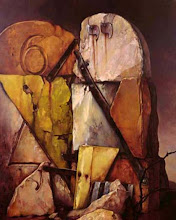
Bak's focus on Albrecht Durer in Elegy III served 'as a desire for revenge'. His comment pushed me to think about Durer and this piece. A German artist whose focus was on linear perspective,geometry of form, ordered ruled for beauty and certainly detail, Durer seems lost and conflicted here (as he holds a ruler). What does he make of all this brokenness? The boy's face seems to be disappearing,the architectural form of an arch (a rainbow?) is held up by a rope; all of the non-linear fragmentation that he sees questions his aesthetics? Durer's angel wings seem to be artificially attached, implying Durer's respected and treasured contribution to aesthetics should be rethought in light of the Holocaust.Everything that was known to be truth and inteligible is questioned here and reframed in light of present truth.
ReplyDeleteElegy defined as a mournful melancholy. The struggle between the divine and humanity. God is trying to negotiate a relationship with hmanity and humanity is also trying to negotiate and understand their relation to the divine. When another "force", "desire" or "entity" is placed into this relationship the consequence is a disruption of the divine-human bond. As a result, the divine mourns (melancholic angel) and the human becomes disjointed, disconnected and identity to the the divine is lost which transmits to a loss of self.
ReplyDeleteWhen I look at this artwork, setting everything original aside and only look at it through the lens of the first commandment, there are many things I see. And then overlaying our reading of Levinas, I see the picture of someone who is so consumed with other things that they don’t see the Other, they aren’t coming face to face with the young boy who is looking directly at her. She doesn’t see him. Some still might see an ‘angel’ in this picture because of the wings, but what if we saw the tablets of the 10 Commandments? Not meant to be a burden, and because it’s behind it’s not a barrier, but rather as something to carry with us as we live out this life of being responsible for the Other. The woman sitting there has the world at her feet, everything is broken around her and the folding measuring stick in her hand is reminding her of her failures and how she isn’t measuring up. And that, that could just be her god, her focus that is creating a barrier between her and God … so much so that she cannot see the young boy who is dying, (nail holes in his hands). She seems to be at a loss and because she isn’t focused on the true God, she cannot and is unable to see the Other…in this case the young boy who is waiting for someone to notice him.
ReplyDeleteThis Art seems to me that as Samuel Bak remembering his past experiences of Holocaust, he manifests disturbing, disruptive properties. Remembering angels remind him time and its material symbols. He seems to counterpoint to the future possibilities and his personal struggle with present realities, time. This art may be3 both about himself, the rest of humanity, his own and our wrestling with God that was silent for most of this 21 century.
ReplyDeleteBlog Post 3
ReplyDeleteWithin Bak’s beautiful and captivating painting, there appears to be not only a picture of a boy who is surrounded by destruction and devestation, but a boy whose face is purposely covered so as to not look at would could be an angel. Connecting this with the commandment “thou shall not have any other gods before me” there is a suggestion that the images and idols are what the boy refuses to look upon, knowing that his faith, hope and trust lies in the one true God, and not the things around him nor those images that are placed before him.
The boy's face seems to be covered by an obstacle which becomes a filter upon which God's face might become less clear and more blunt. In the loss of seeing the face of God, the boy seems to be losing his true form (identity) and becoming something inhumane as becoming part of the wall and not part of the world. With the covering of our eyes to lose sight of God's face seems to, expressed by the boy, imprison us.
ReplyDeleteAdultery group
My first thought upon looking at this painting was, "Busy!" The painting just looked busy, with many different textures and colors. The wall behind the boy appears on one end to be in ruins and on the other to be intact; this could be symbolic of inconsistency or lack of balance. In the midst of all of the busyness is an angelic figure that appears to be unemployed and lacking both stimulation and motivation as a result of the scene taking place before it. When we prioritize the cares of life and demands of the same before God, the same reaction is prompted.
ReplyDeleteWithin the artwork, I see fragmentation, and brokenness. The work is laying on the ground fracture, near the feet of what appears to be an angel. The angel has a book under her arm, can it be filled with the word of the Lord? Was she sent out to proclaim the word of the Lord, but we see her sitting appearing to be tired, or without hope. Is that a ribbon in her hand, have she lost her place God's word, do she no longer know what to proclaim. Can this say of the people of God, who has failed to proclaim the word of the Lord, in the midst of brokenness, and the fragtured lives of the people, the other.
ReplyDeleteThere appear to be pieces of a little boy, who appears to be trying to see, but cannot see, because of the fragments that are blocking his ability to see, his ability to be free. The people of God has a responsibility to preach and teach the Good News of the Gospel Message, in order that men and women, boys, and girls may be whole, and free from the brokenness in their lives.
In the painting, I see a young boy who is trying to hold onto his faith. However, he is fading because his existence as a human as “the other” is being negated by his capturers. The young boy is fading into the wall of the horror that he is forced to endure. One can barely see him or separate him for his situation. The angel is sitting writing in a book with the world at her feet. I wonder if the boy is having difficulty with the first commandment since he is trying to hold onto his faith but he also is experiencing moments when it must seem to him that the God who brought the chosen people out of bondage is not present in his current situation to “bring him out his captivity.”
ReplyDelete